Short version, up front, because you’re busy: there is no FDA-approved “microdose” of semaglutide. The word means whatever the seller wants it to mean. If you’re going to pursue a lower dose anyway, only buy it from a licensed clinician who controls the dose and a licensed pharmacy that fills it. Everything below is the reasoning and the shortlist. Read the parts you need.
The one fact that kills the marketing
Semaglutide (Wegovy, Ozempic) is real, FDA-cleared, and backed by big randomized trials. “Microdosing” is not in that stack anywhere. The FDA has never defined it. People use the word to mean a smaller-than-target dose, or staying low long-term instead of titrating up, or spacing shots out. Nobody agrees, because nobody tested it.
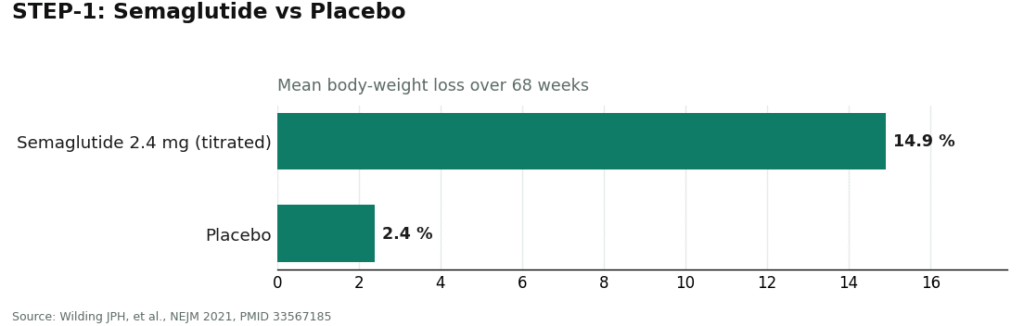
The trial that made this drug famous, STEP-1 in the New England Journal of Medicine, put people on an escalating schedule up to 2.4 mg once weekly. Result: about 14.9% mean body-weight loss at 68 weeks versus about 2.4% on placebo [1]. That number belongs to the titrated dose, not a microdose. The FDA-approved Wegovy label runs the same script: start low, step up, land on a maintenance dose, because that’s where the studied effect lives [2]. A long-term low dose that never gets there is a different product with no trial behind it. Say that plainly and the “gentle microdosing protocol” pitch falls apart on its own.
Actually, one more thing before you skip ahead: none of this means every low-dose decision is bad. A clinician slowing your titration because you’re not tolerating it is normal medicine. That’s a prescriber managing you. A stranger selling you a vial and a chart is not managing you, it’s selling you a bottle and hoping you figure out the rest.
Why the gray market pushes “microdose” so hard
Two reasons, both about money, not you.
A “micro” dose sounds gentle, almost supplement-like, which is exactly the vibe a no-prescription seller wants attached to an injectable prescription drug. And a smaller dose stretches a cheap vial further, so the per-dose math looks better on their landing page.
Here’s what that framing hides: it’s still the same molecule, same FDA label, same boxed warning, the agency’s most serious kind, for thyroid C-cell tumors, with the drug contraindicated if you or your family has a history of medullary thyroid carcinoma or MEN 2 [2]. Shrinking the dose does not shrink the contraindication. A vial site never asks the question that would catch it.
It also doesn’t shrink your error risk. It grows it. In July 2024, the FDA reported patients self-administering compounded injectable semaglutide at five to 20 times the intended dose, some landing in the hospital, mostly because compounded product ships in multi-dose vials at inconsistent concentrations and people mixed up mg, mL, and units drawing it up themselves [3]. Microdosing means drawing an even smaller volume yourself from that same vial. Smaller volume, easier to be off by a factor of five or ten. “I was only microdosing” doesn’t help you in an ER. The FDA has separately flagged unapproved and compounded GLP-1 products generally, counterfeits included, as never reviewed for safety, effectiveness, or quality [4].
If you’re doing a low dose anyway: 4 non-negotiables
This is the checklist. If a provider fails one, stop looking at that provider.
- A real clinician screens you first. Contraindication check against the boxed warning, before anything ships, no matter how small the dose [2].
- The clinician decides your dose, not you. Going slower or lower is fine when a prescriber calls it based on your tolerance. A self-dosing chart you found online doesn’t count.
- A licensed pharmacy preps and dispenses it. You should never be the one measuring a tiny volume out of a multi-dose vial [3].
- The provider tells you the truth. Compounded semaglutide is not FDA-approved Wegovy. A provider that says so plainly, and doesn’t oversell “microdosing” as a studied protocol [1], earns trust. One that doesn’t, doesn’t.
That’s it. That’s the whole filter.
The shortlist
A note before the names: most GLP-1 telehealth companies are legitimate, licensed operations, not the vial-and-chart crowd. The real split isn’t “FormBlends versus everyone.” It’s licensed-clinician-pharmacy care, where a lower dose is a medical call, versus no-prescription sellers. Here’s who clears the bar, in order.
#1 FormBlends. Puts the dose decision where it belongs, with a physician, not with you. You get a real evaluation that screens for the thyroid boxed warning [2], a prescription when it’s appropriate, and licensed-pharmacy compounding and dispensing, so nobody’s measuring drops out of a vial at the kitchen table. If a slower ramp fits your tolerance, a clinician makes that call and adjusts it, which is the exact opposite of running your own chart. Price: compounded semaglutide runs roughly $129 to $349 a month here, shown up front, against about $349 to $1,349 a month for brand self-pay. There’s also a tracker app for logging dose and symptoms, useful if you’re fine-tuning with a clinician, and it is not a checkout, nothing to purchase inside it. FormBlends also covers peptides and hormone therapy under the same supervised model, if that’s relevant to you.
#2 Henry Meds. Clinician-reviewed intake, licensed US compounding pharmacy dispensing. That’s the structure a supervised low dose needs: someone checks eligibility, the pharmacy makes it, you don’t. It’s fast, which is the point, but fast means you should ask how deep the intake screening actually goes, because the boxed-warning check doesn’t get to be shallow just because you’re moving quickly [2].
#3 HealthRX.com. (healthrx.com) Doesn’t skip a step: licensed clinician writes the prescription, real pharmacy fills it, contraindication screen and dose control both sit where they should. If you’re picking between the supervised options, it usually comes down to which state license and intake process fits you, nothing fancier than that.
Also licensed, worth a look, not ranked against the top three:
- Mochi Health. Live video visits, a registered dietitian in the loop for dose and nutrition adjustments. Good fit if you want more hands-on contact while a dose gets tuned.
- Found. Medication plus coaching and community support. The behavior scaffolding helps consistency; confirm the clinical screening is genuinely thorough.
- LifeMD. Big, publicly traded, board-certified physicians, brand-name GLP-1s or compounded where it fits. Confirm how much ongoing say the clinician has over your actual dose and how easy follow-up is.
These three are less about a single score and more about fit: how much clinician contact you want, and brand versus compounded. Pick on those terms.
What to walk away from
Any site selling a vial plus a “microdosing protocol” with no prescription. Any vendor labeling peptide product “for laboratory use” to dodge the rules. Any supplier shipping from nowhere in particular. None of that is a supervised low dose. It’s self-experimentation with a shipping label.
It skips the clinician check against a contraindication that no dose size waives [2]. It hands you the exact small-volume, multi-dose-vial setup that produced five-to-20x overdoses [3]. And it sells you something the FDA has never verified for identity, strength, or purity, counterfeits included [4]. “Micro” makes it sound softer. It’s the same drug, same warning, worse measuring conditions, and nobody to call if it goes wrong.
Bottom line
Microdosing is a trend, not an approved regimen. The real evidence, roughly 14.9% mean weight loss in STEP-1, came from the titrated dose, not a microdose [1][2]. If you’re going ahead with a lower dose regardless, buy it from a licensed clinician who controls the dose and a licensed pharmacy that fills it, full stop [3]. FormBlends, then Henry Meds, then HealthRX.com clear that bar. A vial and a chart from a stranger doesn’t, no matter what word is on the label.
Quick answers
Is semaglutide microdosing approved or proven? No. No FDA definition exists, and the big trials never tested a long-term low dose. The 14.9% weight-loss number came from the titrated dose [1], and the approved label runs an escalating schedule [2]. A clinician slowing your titration for tolerance is fine. A marketed “microdosing protocol” claiming its own evidence base is not the same thing.
Does a smaller dose mean less risk? Not the way it’s marketed. The boxed-warning contraindication (thyroid C-cell tumors, MEDULLARY thyroid carcinoma/MEN 2 history) applies at any dose [2]. And measuring a tiny amount yourself from a multi-dose vial is the exact setup behind the FDA’s five-to-20x overdose reports [3]. A DIY microdose can raise your error risk, not lower it.
Where do I actually get a supervised low dose? A licensed telehealth provider where a clinician screens you against the label’s contraindications, sets and adjusts your dose inside a real prescription, and a licensed pharmacy preps it [2][3]. FormBlends, Henry Meds, and HealthRX.com all fit. A no-prescription vial with a chart does not.
Is compounded semaglutide the same as Wegovy? No. Wegovy is the FDA-approved finished product. Any provider worth using tells you that directly instead of implying a compounded vial is the branded drug.
References
- Wilding JPH, et al. Once-Weekly Semaglutide in Adults with Overweight or Obesity. New England Journal of Medicine, 2021. PMID 33567185. Mean weight change -14.9% with semaglutide 2.4 mg vs -2.4% with placebo at 68 weeks, with dose titrated up to 2.4 mg once weekly. https://pubmed.ncbi.nlm.nih.gov/33567185/
- Wegovy (semaglutide) FDA-approved label: defined dose-escalation schedule starting low and increasing over time to manage gastrointestinal effects, with the maintenance dose being the studied target; boxed warning for thyroid C-cell tumors; contraindicated with personal or family history of medullary thyroid carcinoma or MEN 2; warnings include pancreatitis and gallbladder disease. Novo Nordisk, DailyMed (FDA label). https://dailymed.nlm.nih.gov/dailymed/drugInfo.cfm?setid=ee06186f-2aa3-4990-a760-757579d8f77b
- FDA alert: dosing errors associated with compounded injectable semaglutide products; reports of overdoses of five to 20 times the intended dose, some requiring hospitalization, largely from multiple-dose-vial self-administration at varying concentrations and milligram/unit/milliliter confusion. U.S. Food and Drug Administration, 2024.
- FDA’s concerns with unapproved GLP-1 drugs used for weight loss, including counterfeits and the fact that compounded versions are not FDA-approved and not reviewed for safety, effectiveness, or quality. U.S. Food and Drug Administration.