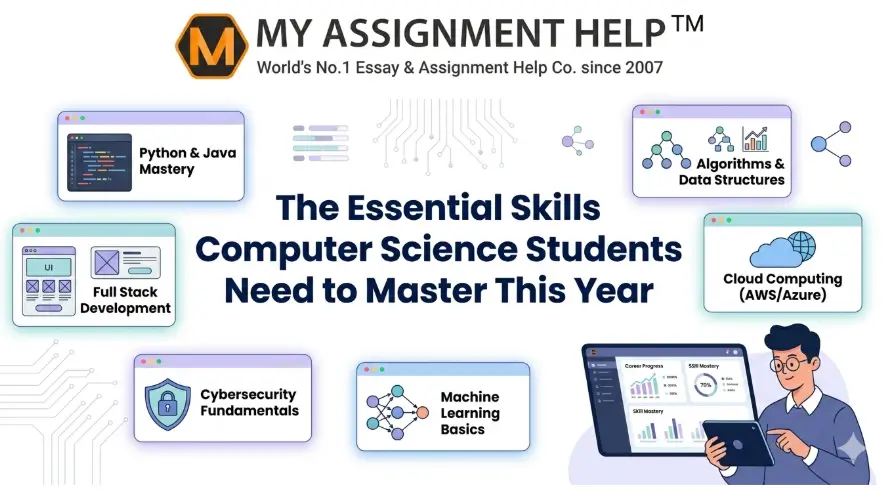
The landscape of technology is shifting at a velocity that can feel both exhilarating and daunting for students. As we move deeper into 2026, the criteria for “industry-readiness” have expanded far beyond the ability to write clean syntax. Today’s computer science (CS) graduates are entering a market where generative AI, data-driven decision-making, and ethical governance are no longer elective topics—they are core requirements (Guettala et al., 2024).
For many students, the pressure to stay ahead can lead to academic burnout. Navigating complex algorithms while keeping pace with emerging frameworks often leaves little room for error. If you find yourself overwhelmed by the technical depth of your curriculum, seeking professional computer assignment help can provide the strategic support needed to master these high-level concepts without sacrificing your GPA.
1. Generative AI and Human-AI Collaboration
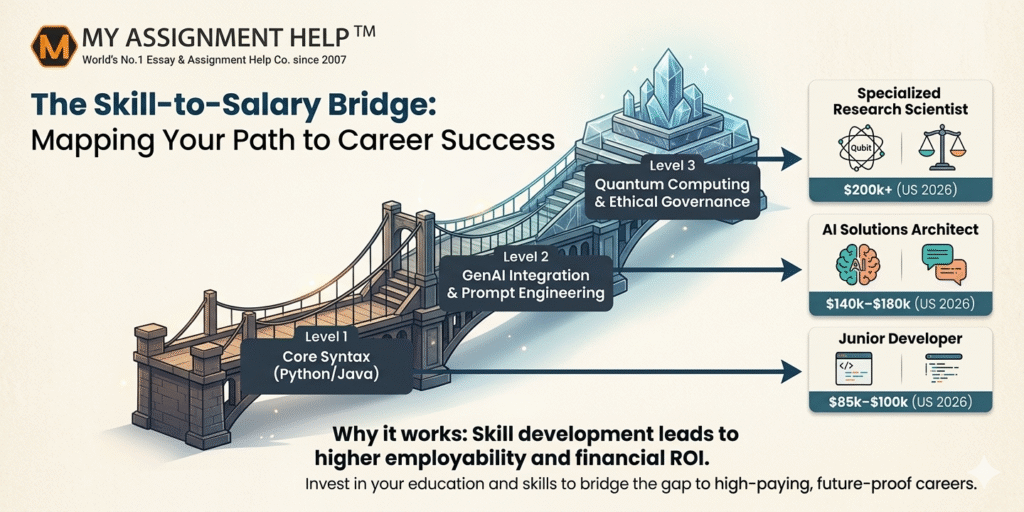
The most significant shift this year is the transition from “AI as a tool” to “AI as a collaborator.” Research indicates that 39% of existing skill sets will be transformed or outdated by 2030 due to automation (Farooqi et al., 2026). Mastering Generative AI (GenAI) is no longer just about using chatbots; it is about understanding LLM architectures, prompt engineering, and the integration of AI into immersive environments like AR/VR (Coban et al., 2025).
Mastery Check:
- Integrating LLMs into software development workflows.
- Understanding AI-detection tools and academic integrity frameworks.
- Developing AI-driven adaptive platforms and IoT applications (Dong et al., 2024).
2. Data-Driven Decision Making and Predictive Analytics
In the modern data era, companies are moving away from human intuition toward predictive analytics. Machine learning (ML) has become the core solution for interpreting multifaceted data to recognize trends and provide foresight (Perumal et al., 2024). Students must be proficient in extracting patterns and making informed decisions without requiring specific code for every possible situation (Gade, 2021).
Many students struggle with the mathematical rigor required for these models. If the workload becomes unmanageable, it is common for students to look for reliable services to pay someone to do my assignment, ensuring their projects meet the high standards of authoritativeness and accuracy required in 2026.
3. Ethical Governance and Algorithmic Bias
As AI becomes more pervasive, the demand for “ethical literacy” has skyrocketed. Employers are looking for engineers who can navigate transparency, algorithmic bias, and socioeconomic inequality (Castro et al., 2024).
Key areas of focus include:
- Epistemic Trust: Ensuring AI tutors and tools are accountable and reliable (Tanchuk & Taylor, 2025).
- Privacy & Security: Addressing the “trust gap” in digital platforms and employment systems (Qudrat-Ullah, 2026).
- Sustainability: Understanding the “AI-Energy Nexus” and the ecological impact of large-scale computing (Tsoukalas, 2026).
4. Advanced UI/UX and User-Centered Design
Technical skill alone does not guarantee employability. Recent studies show that proficiency in UI/UX design significantly influences the career success of IT undergraduates (Senadheera et al., 2026). As companies adapt to digital change, they prefer personnel who can create seamless, engaging user experiences that drive customer satisfaction.
5. Specialized Subfields: Quantum and Edge Computing
While entry-level web development is seeing increased competition from AI, specialized subfields like quantum computing and AI research are considered significantly more secure from displacement (Farooqi et al., 2026). Students aiming for high-security roles should consider specializing in:
- Quantum Computing: A field less likely to be replaced by current LLMs.
- Edge Computing: Real-time analytics and decentralized data processing.
- HPC Models: High-performance computing validated on massive datasets (Huang et al., 2025).
Key Takeaways for 2026
- AI Literacy is Non-Negotiable: Move beyond basic coding; learn to collaborate with AI to increase productivity.
- Focus on EEAT: Build projects that demonstrate Experience, Expertise, Authoritativeness, and Trustworthiness.
- Soft Skills Matter: Communication, problem-solving, and critical thinking remain the primary moderators of career success (Wijnia et al., 2024).
- Bridge the Gap: Transition from block-based or basic scripting to professional languages like Python and Java for quantitative finance and data modeling (Bilokon et al., 2026).
See also: Why Is My Cat Avoiding the Litter Box? Hidden Risks You Should Not Ignore
FAQ Section
Q: Which programming languages are most important in 2026?
A: Python continues to lead due to its dominance in AI and data science. However, Java remains critical for large-scale enterprise systems, and JavaScript is essential for interactive web applications and UI/UX projects (IMF, 2026).
Q: How is AI affecting the CS job market for graduates?
A: While job postings in some sectors have declined, new roles are emerging in AI governance, prompt engineering, and ethical auditing. Specializing in “less replaceable” fields like quantum computing or AI research offers higher job security (Farooqi et al., 2026).
Q: What is the biggest “trust gap” in technology right now?
A: Research shows a significant trust gap in automated employment recommendation systems due to information lag and poor matching algorithms. Future developers need to focus on dynamic, user-centric engagement (Qudrat-Ullah, 2026).
Author Bio
Alex Rivera is a Senior Content Strategist at MyAssignmentHelp. With over a decade of experience in the EdTech sector, Alex specializes in bridging the gap between academic theory and industry application. He currently manages digital content strategies across US and Australian markets, helping CS students navigate the complexities of modern software engineering through data-driven insights and expert academic support.
References
- Bilokon, P. A., Jacquier, A., Mackie, E., & Muguruza, A. (2026). An Introduction to Python for Quantitative Finance. World Scientific Publishing.
- Castro, V., et al. (2024). Ethics and governance in the adoption of AI. Frontiers in Education.
- Farooqi, D., Pu, G., Paudel, S., Sultana, S., & Ahmed, S. I. (2026). Job Anxiety in Post-Secondary Computer Science Students Caused by Artificial Intelligence. Proceedings of the 2026 ACM Conference on Fairness, Accountability, and Transparency (FAccT ’26). https://doi.org/10.1145/XXXXXXXX
- Guettala, A., et al. (2024). Integrating generative AI with adaptive platforms. Frontiers in Education, 5.1.
- Perumal, V., et al. (2024). Machine Learning Driven Decision Making in the Modern Data Era. Perfect Journal, 2(1).
- Senadheera, D., & Wisenthige, K. (2026). Assessing the influence of diverse skills on employability outcomes for IT undergraduates. PMC Journal.
- Tanchuk, N., & Taylor, L. (2025). Epistemic trust and accountability in AI tutors. Frontiers in Education.